
Shipper Bitutainer™
Cold Bitumen Transport
The Shipper Bitutainer™ is TEC’s highest capacity bitumen container, purpose-built for moving bitumen cold across long sea, road and rail routes. At 29m³ it carries around 30% more product than a conventional tank container, within standard 20ft ISO dimensions.
It is designed for the reality of long distance bitumen export. Holding a load at working temperature for three or four weeks at sea is expensive, energy intensive and exposed to every delay in the schedule. The Shipper is built for the alternative: the bitumen travels cold, and the double-walled construction means it returns to working temperature quickly and efficiently once it arrives.
Transporting bitumen hot? The Shipper is certified for cold transport.
For heated transport, see the ADR/RID Bitutainer™ or IMDG Bitutainer™.
Moving bitumen over long distances and finding heated transport uneconomic?
Maintaining bitumen at working temperature across a multi-week ocean voyage carries a continuous energy cost and a continuous risk. A delayed berth, a missed connection or a week at anchor can turn a planned discharge into a recovery operation. Cold transport removes both. The bitumen travels stable and is reheated when it reaches the receiving facility, which is where the energy is actually needed.
Losing payload to tank weight?
The Shipper carries 27 tonnes of bitumen nominally, with a maximum payload of 28,825kg and a tare weight under 6,300kg. Its 29m³ capacity is roughly 30% greater than a conventional 20ft tank container, which typically holds between 21m³ and 27m³. On a long haul route, that difference changes the number of units you need to move a given tonnage.
Concerned about reheat time and energy cost at the destination?
The double-walled construction with a mineral wool insulated cavity is not there to hold temperature in transit. It is there to make reheating faster and more efficient on arrival. An insulated tank returns to working temperature on less energy, and in less time, than an uninsulated one. Three heating configurations are available: direct fire, steam or thermal fluid, and electrical.
Need a container that survives the route rather than just the first trip?
Bitutainers™ have been in continuous service for over twenty years, with tanks still operating two decades after manufacture. The Shipper is built with internal reinforcement, impact protection on commonly damaged areas, and a customised high temperature paint specification. Long asset life and strong residual values are a function of how it is built, not how it is marketed.
Why ship bitumen cold?
Cold bitumen transport means moving bitumen at ambient temperature rather than maintaining it in a fluid state throughout the journey, then reheating it at the destination before discharge.
For long distance and international movements it is often the more practical option, for three reasons.
Cost
Heating a tank continuously for three or four weeks consumes fuel or power for the entire voyage. Cold transport moves that energy demand to a single controlled reheat at the receiving facility, where the infrastructure and supervision already exist.
Risk
Bitumen in transit is losing heat from the moment it is loaded. Every delay increases the gap between loading temperature and arrival temperature. On a long route with multiple transfers and port dwell, a load that was planned to arrive workable can arrive marginal. Cold transport removes that variable, because there is no temperature to protect.
Compliance
Hot bitumen is a dangerous goods cargo requiring ADR, RID or IMDG approval depending on the mode. Cold bitumen movements do not carry the same requirement. The Shipper holds CSC, TIR and ISO 1496 certification and is specified for cold transport. If your route requires heated transport, the ADR/RID and IMDG Bitutainers™ are certified for it.
Where cold transport does carry a cost is at the destination, in reheat time and energy. That is the specific problem the Shipper’s double-walled construction is designed to reduce.
Our guide to bitumen handling and temperature control covers what happens to bitumen across the journey in more detail.
Features of the Shipper Bitutainer™
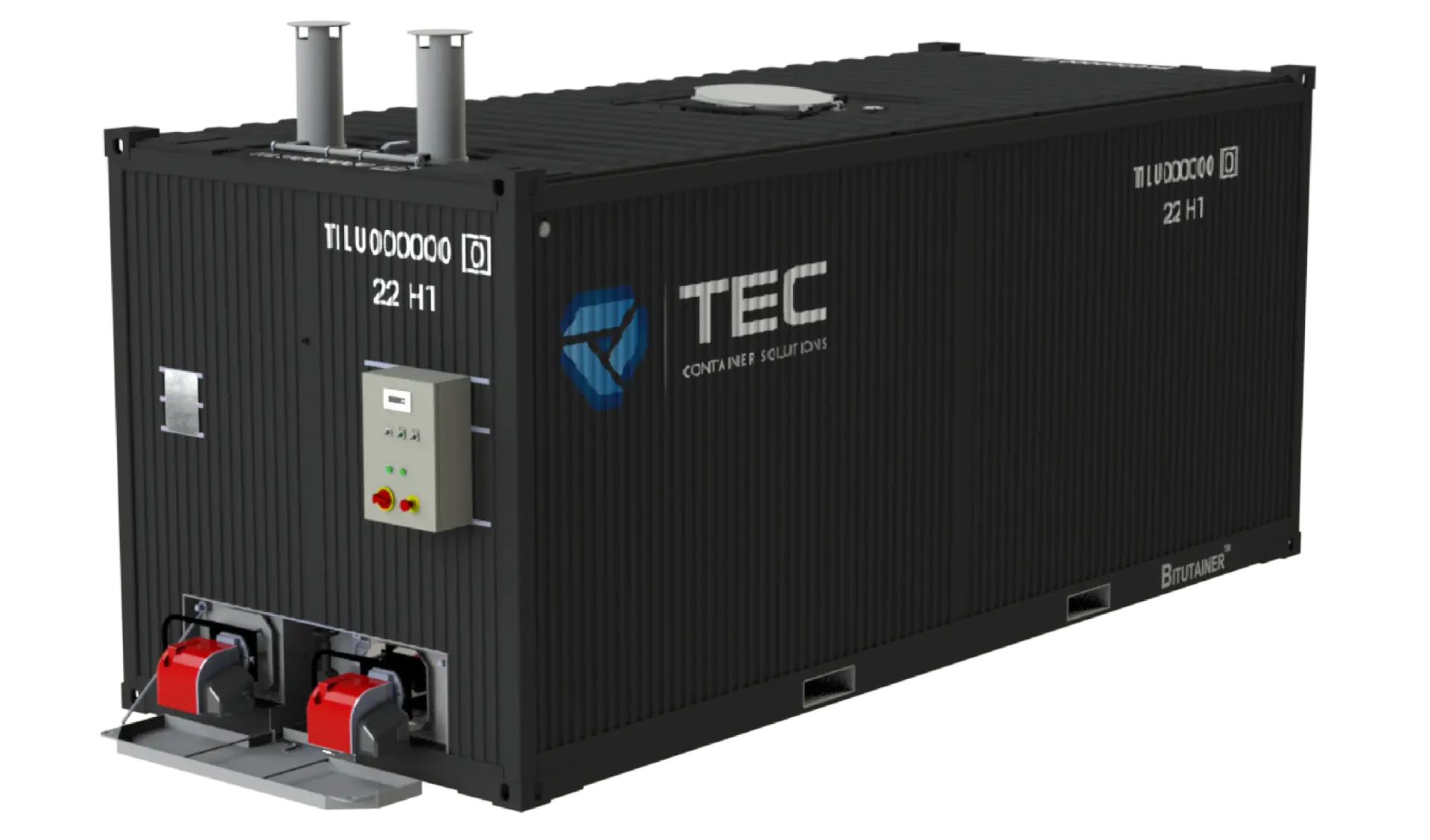
Optimised heating operations
Insulated cavity
27 tonne fill capacity
Double-walled construction
Standard iso container dimensions
Standard iso container dimensions
Shipped as standard 20ft ISO Container for simplistic transport logistics.
Optimised heating operations
Range of heating systems and sloped floor for maximum discharge.
Double-walled construction
Built with a durable internal tank and protective double-wall, featuring impact protection, ensuring longevity and resistance during operations.
Insulated cavity
Featuring an insulated internal cavity, engineered for enhanced thermal performance.
27 tonne fill capacity
Fill capacity of 27 tonne per load, ensuring efficient transport operations.
Specifications
Full technical specification for the Shipper Bitutainer™. For a printable version, download the datasheet.
| Specification | Shipper Bitutainer™ |
|---|---|
| Max capacity | 29 m³ |
| Nominal bitumen payload | 27 tonnes |
| Max payload | 28,825 kg |
| Max gross weight | 35,125 kg |
| Tare weight | Under 6,300 kg |
| External dimensions | 6,058 mm × 2,438 mm × 2,591 mm (20ft ISO) |
| Working pressure | 0.25 bar |
| Test pressure | 0.45 bar |
| Inner tank material | Weather resistant carbon steel |
| Insulation | Mineral wool insulated cavity, double-walled construction |
| Stacking load | Up to 192,000 kg |
| Certifications | CSC, TIR, ISO 1496 |
| Intermodal compliance | ISO 668, with ISO 1161 corner castings |
| Transport modes | Sea, road and rail |
| Suitable products | Bitumen, asphalt, bitumen emulsions, PMBs, heavy fuel oils |
| Design life | 20+ years, proven in operation |
| Feature | Detail |
|---|---|
| Discharge | 3" gate valve in low level sump for maximum product recovery |
| Primary fill point | 300 mm fill point through centrally mounted manway |
| Secondary fill point | 3" flanged connection with internal riser |
| Access | 600 mm manway with galvanised cover and removable insert |
| Valve protection | Galvanised reinforced valve area cover with removable securing chains and locking pins |
| Temperature monitoring | Integrated thermowells, mechanical dial thermometer supplied |
| Pressure relief | Pressure vacuum relief valve, 0.25 bar pressure, 0.5 Hg vacuum |
| Burst disc | Available as an option, not fitted as standard |
| Empty handling | Forklift pockets for lifting when empty |
| Coating | Customised Bitutainer™ high temperature paint specification |
Heating options
Three heating configurations are available. The right choice depends on the receiving facility, the available services on site, and how quickly the load needs to be discharged after arrival.
| Heating type | Supplied as standard | Optional equipment |
|---|---|---|
| Direct fire | 10" and 8" seamless pipe heater tubes, burner attachment fittings, collapsible exhaust flues | Flame liners (carbon or stainless steel), complete burner set (diesel or gas powered) |
| Steam / thermal fluid | 2" seamless pipe heating coil with ANSI Class 150 flanges | Isolation valves |
| Electrical | 2" seamless pipe heating | Heating element set, control panel |
Not sure which heating configuration suits your operation? Speak to our engineering team
Example Projects

Streamlining Bulk Bitumen Imports in the Philippines
To support growing infrastructure demands, a major asphalt supplier in the Philippines needed a solution for importing bulk bitumen into a new terminal facility. TEC supplied a fleet of Shipper Bitutainers™ to enable consistent, multimodal transport from overseas refineries. The tanks integrated seamlessly with on-site operations, delivering temperature-stable bitumen ready for immediate use.
Multimodal
Island logistics
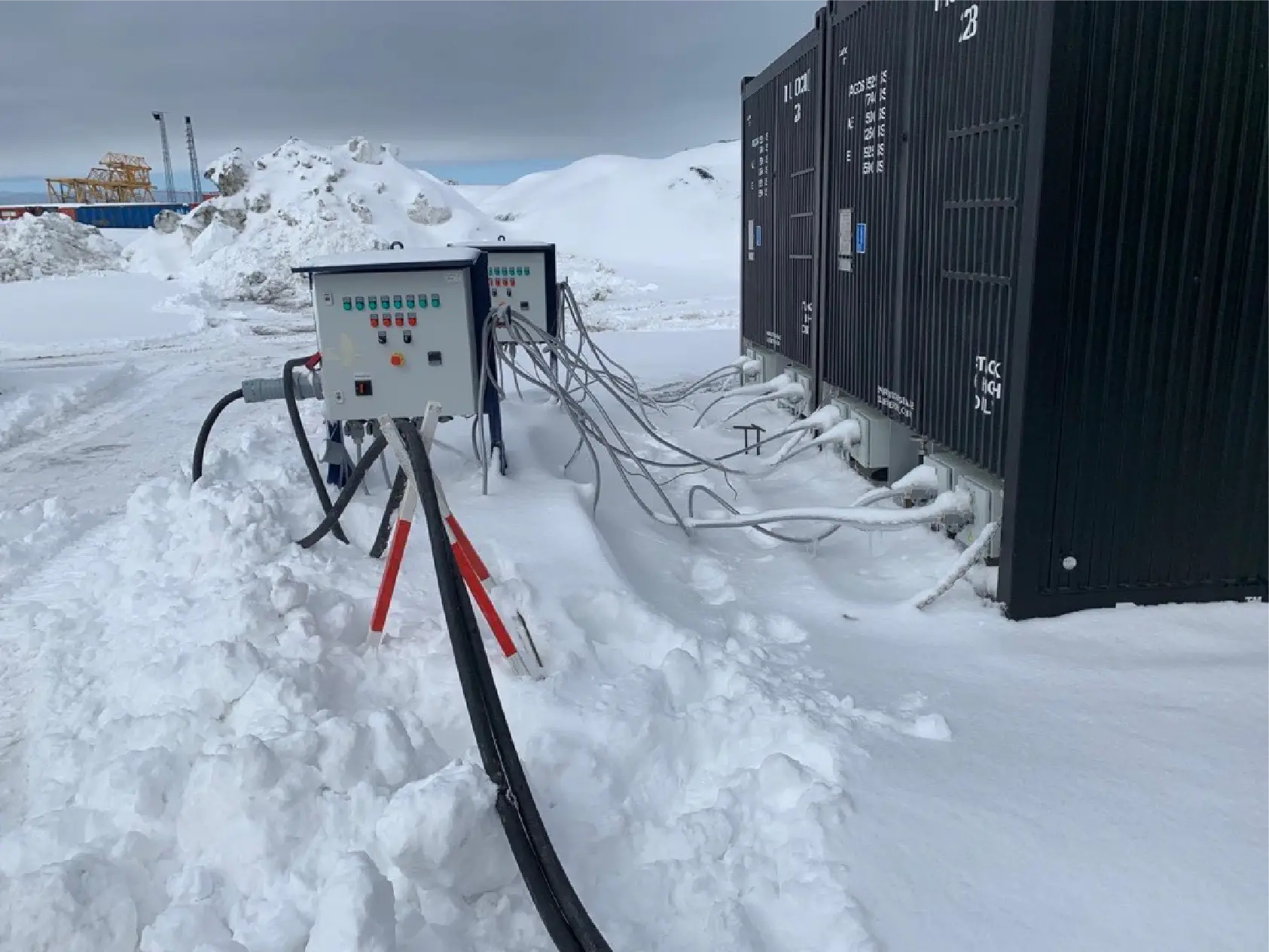
Supporting bitumen operations in Greenland
A leading infrastructure contractor selected the Shipper Bitutainer™ for a large-scale airport resurfacing project in Greenland, where sub-zero temperatures and snow-covered terrain posed serious challenges for bitumen handling. The tank’s double-walled construction and enhanced thermal insulation proved critical, ensuring bitumen remained at optimal temperatures throughout transport and on-site operations. Competing solutions struggled with heat retention in such extreme conditions, but the Shipper Bitutainer™ delivered consistent performance without costly reheating delays. The result was a reliable, uninterrupted supply chain that kept resurfacing operations on track despite the harsh Arctic environment.
Electrical
heating config.
Ready to optimise your bitumen transport?
Looking for a cost-effective, reliable, and compliant solution for bulk bitumen transport? The Shipper Bitutainer™ is designed for seamless global logistics across road, rail and sea.
Tell us about your requirements, and our team will provide expert guidance. Submit your enquiry today and get your response within 24 hours.
Can the Shipper Bitutainer™ transport hot bitumen?
No. The Shipper is certified to CSC, TIR and ISO 1496 and is specified for cold bitumen transport. Hot bitumen is a dangerous goods cargo requiring ADR, RID or IMDG approval depending on the mode. For heated transport, TEC’s ADR/RID and IMDG Bitutainers™ hold the relevant certifications.
What is cold bitumen transport?
Cold bitumen transport means moving bitumen at ambient temperature rather than maintaining it in a fluid state throughout the journey, then reheating it at the destination before discharge. It is commonly used on long international routes where holding temperature for several weeks is uneconomic and exposed to schedule delays.
How much bitumen does a Shipper Bitutainer™ hold?
The Shipper has a maximum capacity of 29m³ and carries approximately 27 tonnes of bitumen nominally, with a maximum permitted payload of 28,825kg. That is roughly 30% more product than a conventional 20ft tank container, which typically holds between 21m³ and 27m³.
What heating options are available?
Three configurations. Direct fire heating uses 10″ and 8″ seamless pipe heater tubes with burner attachment fittings and collapsible exhaust flues. Steam or thermal fluid heating uses a 2″ seamless pipe coil with ANSI Class 150 flanges. Electrical heating uses 2″ seamless pipe with an optional element set and control panel.
What certifications does the Shipper Bitutainer™ hold?
CSC, TIR and ISO 1496. It is fully intermodal, compliant with ISO 668 and fitted with ISO 1161 corner castings for standardised lifting. It does not hold ADR, RID or IMDG approval, which is why it is specified for cold rather than heated bitumen transport.
Can it be used for bitumen storage?
It can, and has been on remote projects where establishing dedicated storage was impractical. For planned storage requirements TEC’s High Performance and High Capacity Storage Bitutainers™ are purpose-built for the application and hold roughly twice the volume.
What products can it carry besides bitumen?
The Shipper is specified for bitumen, asphalt, bitumen emulsions, polymer modified bitumen and heavy fuel oils. Suitability for a specific product depends on the route and the certifications required, which TEC’s engineering team confirms at quote stage.
Answers to
Not sure if the Shipper Bitutainer™ is the right fit for your operations? Our expert team is here to help. Whether you have questions about specifications, heating options, or logistics, we’ll provide the insights you need to make an informed decision.
Ask us your questions today and get expert guidance on your bitumen transport needs.
Explore Related Products
Explore more solutions from the Bitutainer™ range and essential equipment for bitumen handling.
ADR/RID Bitutainer™
Transport
ADR/RID Bitutainer™
Transport
IMDG Bitutainer™
Liquid Transport
IMDG Bitutainer™
Liquid Transport
Heating Equipment
ADR/RID Bitutainer™
ADR/RID Bitutainer™
IMDG Bitutainer™
IMDG Bitutainer™
Heating Equipment
Heating Equipment
Related guides
Technical guidance from the TEC team on handling, transporting and storing bitumen products.

How Bitumen Reaches the Road
Why temperature control across the journey determines pavement quality, and what goes wrong when it slips.
Regulations for Bitumen Transport
What ADR, RID and IMDG require, and how the framework changes by transport mode and route.
How Is Bitumen Transported?
Road tankers, rail, sea and containerised transport compared, with the trade-offs of each.