
For years, fixed tank farms have been the default solution for large-scale bitumen storage. These permanent installations are well understood and often specified early in infrastructure planning. But as projects become more dynamic and cost-sensitive, many operators are beginning to question whether fixed tanks still offer the best fit.
This article compares fixed and modular storage across deployment speed, cost, maintenance, and logistics. It also challenges common assumptions about modular systems being temporary or limited in scope, and highlights where containerised solutions are now outperforming traditional tanks in real project environments.
Challenging the belief that modular means short term
A common assumption in the industry is that modular storage is only appropriate for short-term or temporary use. In reality, containerised bitumen facilities have been used successfully on multi-year projects across Africa, Europe, and Oceania. These systems are not stopgap solutions but engineered, long-term assets designed for repeat deployment and long-duration service.
Where fixed tanks are typically installed once and left in place indefinitely, modular units offer greater flexibility. They can remain on site for as long as needed or be relocated and reused when demand shifts. This versatility is especially useful in markets where projects are phased or site usage evolves over time.
Comparing setup and deployment times
Fixed asphalt tanks often require extensive groundworks, including poured foundations, gantries, and site-based assembly. Permitting can add further delays, especially when environmental or planning approvals are required. The result is a deployment timeline that may extend for several months before the first load of bitumen is received.
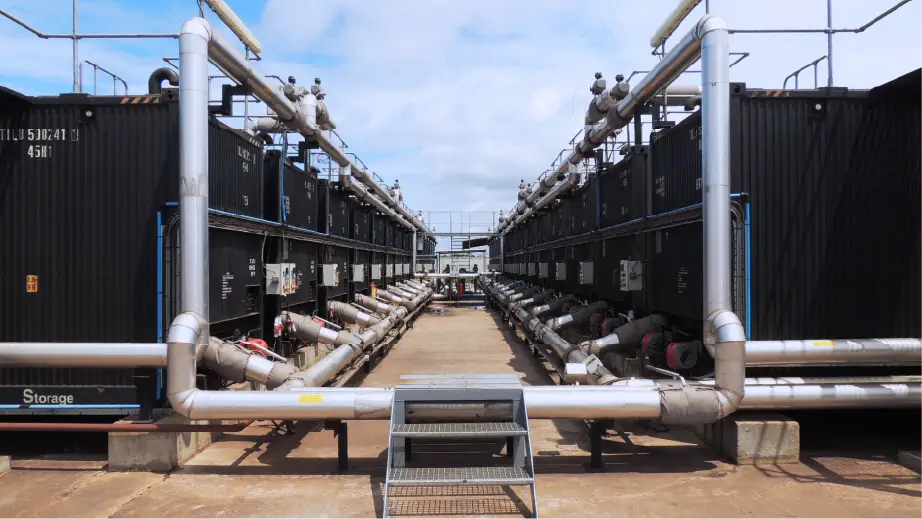
Modular Bitutainer™ Storage Facilities are designed to reduce that lead time. Tanks are delivered pre-engineered and ready to connect. Minimal site preparation is needed, and installation is handled using standard lifting equipment. In one project in West Africa, over 1,000 tonnes of bitumen storage was deployed in stages, with each phase operational in a matter of weeks. This allowed the project team to scale operations gradually without the delays often associated with permanent infrastructure.
Cost and scalability over the full project lifecycle
Fixed tanks may offer favourable unit pricing at scale, but they come with significant hidden costs. Civil works, installation, utility connection, and final decommissioning can all add to the total investment. In many cases, these tanks are never reused, particularly when tied to a single site or permit.
Modular systems offer a more flexible capital model. Capacity can be scaled as needed and spread across multiple project phases. Tanks can be transferred to future jobs or redeployed to different parts of the same network. For contractors working across multiple geographies or phases, this flexibility helps protect both capital and long-term value. Over time, the ability to reuse modular tanks reduces cost per tonne stored and supports more agile planning.
Maintenance and operational efficiency
Once installed, fixed tanks typically rely on centralised heating and control systems. These can be difficult to access and service, particularly when space is tight or equipment is exposed to harsh environments. A fault in one system may require shutdowns across the entire facility, increasing downtime.
By contrast, Bitutainer™ systems are built for unit-level access and individual servicing. Each tank is equipped with its own integrated heating and control setup, allowing maintenance to be scheduled around operations. If a single unit requires inspection or repair, it can be isolated without affecting the rest of the facility. This approach supports more consistent availability and simplifies technical support, especially in locations with limited engineering access.
Where modular works best
Modular storage has proven especially effective in projects where flexibility, speed, or site access are limiting factors. These include port-based staging hubs, phased road construction projects, and operations in infrastructure-poor regions.
One example is a large-scale facility established in West Africa. Bitutainer™ units were used to manage bulk bitumen imports during a port development project. The ability to scale capacity, reposition tanks, and maintain product temperature in a tropical climate helped the operator meet tight supply schedules without the sunk costs of fixed tank construction.
Modular vs fixed bitumen storage
| Feature | Fixed Tank Farm | Bitutainer™ Storage Facility |
|---|---|---|
| Installation time | 4 to 6 months minimum | 2 to 4 weeks |
| Site preparation | Foundations, permits, gantries | Flat ground, basic prep |
| Capital flexibility | High upfront investment | Scalable in phases |
| Portability | Non-relocatable | Fully relocatable |
| Maintenance access | Centralised systems | Unit-level access |
| Decommissioning and reuse | High cost, often non-recoverable | Reusable across projects |
| Best use cases | Permanent facilities | Remote, phased, or mobile sites |
Fixed Tank Farm
- Installation time: 4 to 6 months minimum
- Site preparation: Foundations, permits, gantries
- Capital flexibility: High upfront investment
- Portability: Non-relocatable
- Maintenance access: Centralised systems
- Decommissioning and reuse: High cost, often non-recoverable
- Best use cases: Permanent facilities
Bitutainer™ Storage Facility
- Installation time: 2 to 4 weeks
- Site preparation: Flat ground, basic prep
- Capital flexibility: Scalable in phases
- Portability: Fully relocatable
- Maintenance access: Unit-level access
- Decommissioning and reuse: Reusable across projects
- Best use cases: Remote, phased, or mobile sites
Making the right choice for your next project
Fixed tanks still have a role to play in certain large-scale, long-term facilities. But for many infrastructure and bitumen supply projects, modular storage systems offer a better balance of cost, flexibility, and operational efficiency.
TEC’s Bitutainer™ Storage Facility has been deployed globally to support critical infrastructure programmes. Whether your priority is speed, scalability, or long-term asset value, containerised storage offers a practical alternative to fixed tank investment.
Explore the Bitutainer™ Storage Facility →
Read our latest use-case insights →