
Bitumen storage is no longer only about building permanent tank farms near major asphalt plants. Across infrastructure projects, contractors and suppliers are increasingly looking for storage systems that can move with demand, adapt to temporary sites, and support changing project scopes without the delay and cost of fixed installation.
That is where mobile bitumen storage becomes relevant. It offers a practical answer for operations that need heated storage capacity on site, closer to the point of use, and without the long lead times associated with permanent infrastructure.
This guide explains what mobile bitumen storage is, when it makes sense, and why it is becoming a more attractive option for roadworks, regional projects, and flexible bitumen logistics.
What is mobile bitumen storage?
Mobile bitumen storage refers to heated storage systems that can be deployed to site, commissioned quickly, and relocated when operational needs change. Unlike traditional vertical tank farms, mobile units are designed to be transportable and self-contained, often with integrated heating, insulation, control systems, and pipework.
In practice, this means mobile storage is not simply a smaller version of a tank farm. It is a different operational model. It allows bitumen to be positioned closer to where it will actually be used, whether that is a remote road project, a temporary asphalt plant, or a regional distribution point.
Why the industry is shifting toward more flexible storage
Bitumen logistics have changed. Project timelines are tighter, sites are often more decentralised, and infrastructure contractors are under pressure to reduce idle time between supply and application. In that environment, fixed storage can become a constraint rather than an advantage.
A permanent tank installation makes sense where demand is stable, throughput is high, and the site will remain active long enough to justify civil works and fixed infrastructure. Many projects do not look like that anymore. They are seasonal, phased, remote, or spread across multiple sites.
Mobile bitumen storage fits this change because it allows supply to be placed where it is needed, then moved when conditions change. That flexibility is one of the main reasons it has become a more commercially relevant search topic than general bitumen storage alone.
What mobile bitumen storage is designed to solve
The core strength of mobile bitumen storage is that it reduces the distance between stored product and actual use. That has several knock-on benefits.
For one, it reduces the handling stages between arrival and discharge. It can also cut waiting time for transport assets, minimise reheating requirements between transfers, and help operators maintain tighter control over material condition.
This is particularly important on infrastructure projects where bitumen is not simply held in reserve but used as active buffer stock. In these situations, storage is part of the delivery workflow, not just a holding point.
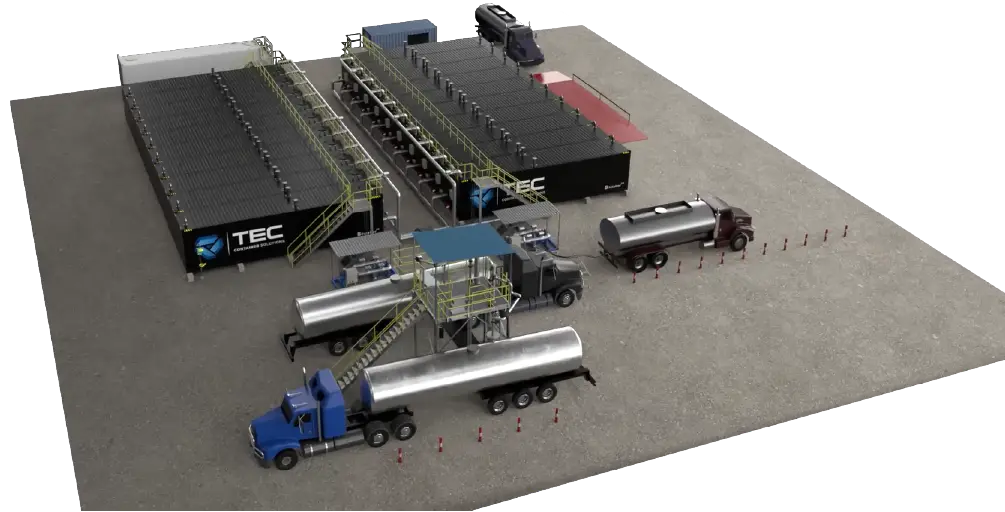
Mobile systems are often most useful where operators need to:
- add temporary heated storage without permanent civil works
- support a remote, seasonal, or phased roadworks programme
- create bitumen buffer storage close to live operations
- expand capacity quickly when demand changes
Those use cases are closely aligned with the broader move toward containerised and modular logistics. They also explain why mobile storage is increasingly discussed alongside transport efficiency rather than only storage capacity.
How mobile bitumen storage differs from fixed storage
The difference is not just mobility. It is the entire setup model. Fixed tanks are built around permanence. They usually require site preparation, foundations, bunding, pipework installation, and dedicated heating systems. Once in place, they are difficult and expensive to move.
Mobile storage, by contrast, is built around deployment speed and operational flexibility. TEC Bitutainer™ Storage range, for instance, promotes rapid on-site setup, multiple heating options, and the ability to connect several units together to create a larger storage arrangement.
For buyers, the important distinction is that mobile storage changes the commercial model. Instead of investing in one fixed location, operators can deploy storage capacity across multiple projects over time. That can significantly improve asset utilisation where demand is variable.
For a broader comparison of permanent and modular approaches, this article on modular vs fixed bitumen storage gives useful context.
When mobile bitumen storage is the right solution
Mobile bitumen storage is most valuable when operational flexibility matters more than permanent site infrastructure. That includes projects where location, duration, or production profile changes over time.
It is often the right solution for regional roadworks, temporary asphalt production, spray seal operations, and remote infrastructure projects where establishing a conventional storage terminal would take too long or cost too much.
It also suits operators who need buffer storage but do not want to overbuild. In many cases, the requirement is not for a major tank farm. It is for a practical amount of heated storage on site, available when needed and movable when the job changes.
The right fit usually comes down to a few questions:
- Is the project temporary, phased, or remote?
- Is there a need to avoid civil works and fixed site preparation?
- Does the operation need bitumen storage close to the point of use?
- Would movable storage improve supply reliability or reduce waiting time?
If the answer to those questions is yes, mobile storage is often a better fit than a fixed installation.
Why this matters for infrastructure and roadworks
Bitumen demand often follows the rhythm of infrastructure work. That means storage has to support live delivery, not just long-term holding. On roadworks projects in particular, timing matters. If material is too far from the application point, transport and reheating inefficiencies start to affect the wider programme.
This is why mobile asphalt storage and on-site bitumen storage have become more commercially relevant. They are not just about convenience. They are about reducing disruption, protecting material quality, and giving operators a practical way to match storage capacity to project reality.
That also makes mobile storage highly relevant to modern roadworks planning. For a regional perspective, TEC’s article on why modular bitumen storage is gaining ground in Australia and New Zealand shows how these pressures are already shaping project decisions in the field.
Where TEC fits into this picture
TEC’s approach to mobile and modular bitumen logistics is built around giving operators more control over where and how product is stored. Rather than treating storage as a permanent civil installation by default, TEC’s systems are designed around real project requirements such as mobility, thermal performance, operational simplicity, and scalability.
This is especially relevant for businesses looking at containerised bitumen storage rather than conventional tanks. Modular systems make it possible to add storage capacity where it is needed, link units when demand grows, and redeploy them later when the project changes.
That is why mobile storage is not just a technical category. It is also a strategic one.
MEST Bitutainer™
Bitumen Storage Solution
MEST Bitutainer™
Bitumen Storage Solution
Making the right decision
Mobile bitumen storage is the right solution when an operation needs heated storage capacity without the time, cost, and rigidity of a fixed installation. It is particularly valuable for temporary sites, regional roadworks, phased infrastructure programmes, and any operation that benefits from buffer storage at the point of use.
For buyers researching mobile bitumen storage, temporary bitumen storage, or containerised storage systems, the real question is not whether fixed storage still has a role. It does. The better question is whether a project actually needs permanence, or whether flexibility will deliver better operational value.
If the priority is speed, mobility, and scalable on-site capacity, mobile storage is often the more effective answer.
Request your bespoke quote to find out how TEC’s Bitutainer™ range can improve your bitumen storage operations.