
There is a lot of published material about how bitumen is produced, and a lot about how asphalt is laid. There is very little about what happens in between.
That gap matters, because it is where most avoidable problems occur. Bitumen does not leave a refinery, travel down the road and go straight into a paver. There is a chain of loading, transport, waiting, discharge, storage, pumping and, in most road construction applications, mixing with aggregate at the asphalt plant before the finished material reaches the paving operation. Every one of those steps is an opportunity for the product to arrive in a condition nobody planned for.
This article covers what actually happens to bitumen across that chain, what goes wrong, what it costs, and what good handling looks like in practice. For an overview of the transport methods themselves, see our guide to how bitumen is transported. What follows is about the condition the product arrives in.
Temperature is not a state, it is a countdown
At the refinery, bitumen is loaded at a temperature appropriate to the grade and the planned journey. From that moment it is losing heat continuously. The rate depends on the tank, the insulation, the fill level, the ambient temperature, wind, rain, journey time, and how long the load waits before it can be discharged.
Temperature governs viscosity, and viscosity governs whether the product can be moved. As bitumen cools it becomes progressively harder to pump and transfer. At elevated temperatures it behaves more like a conventional liquid, but the delivery temperature still has to match both the grade and the receiving operation.
Industry guidance generally relates handling temperatures to viscosity rather than treating a single figure as correct for every product. A commonly cited working rule is approximately 100 cSt for storage, 200 cSt for handling and no more than 500 cSt for pumping, consistent with the technical guidance published by Eurobitume, the European bitumen association. The binder supplier’s own recommendations always take priority over any general rule.
The practical consequence is that there is no universally correct delivery temperature. There is only the temperature that this grade needs, for this operation, at this point in the chain.
The two things people underestimate
Waiting time. Most planning calculates driving time. It does not always allow for a delayed loading slot, customs clearance, a port movement, a missed ferry, traffic restrictions, a receiving tank that is not ready, or a site that cannot accept the delivery immediately. Bitumen does not care whether the vehicle is moving or sitting in a queue. It continues to cool at broadly the same rate either way.
Interfaces. A load can arrive at an entirely acceptable bulk temperature and still fail operationally, because the outlet, hose, pump or receiving pipework is too cold, blocked or incorrectly configured. The temperature in the centre of the tank tells you very little about whether the product will move successfully through every component downstream.
This is why successful hot bitumen logistics starts at the discharge point and works backwards, rather than starting at the refinery and working forwards.
What actually happens when bitumen arrives at the wrong temperature
Too cold: The first sign is usually a slower than expected discharge. The pump works harder, flow rates fall, and the remaining product becomes progressively more difficult to remove. In a worse case, valves, pumps or lines block and the load has to be reheated before operations can continue. That reheating can take hours, and it interferes with the asphalt plant programme, the paving gang, the delivery schedule and any traffic management already installed.
Too hot: This is not a success either. Excessive temperature increases fuming and safety risk. Prolonged storage or repeated heating at unnecessarily high temperatures accelerates oxidation and hardening. Local overheating around heater elements or coils can create coke deposits that later interfere with pumping and mixing.
There is a practical window between having enough fluidity to move the product and applying more heat than the operation actually needs. Good temperature control is about staying inside that window, not about being as hot as possible.
The three handling mistakes we see most often
1.Treating temperature as a tank reading rather than a system condition.
Someone checks a gauge, sees an acceptable number and concludes the bitumen is ready. Meanwhile the outlet valve is cold, the hose has not been prepared, the pump is unsuitable, or the receiving pipework is not heat traced. The product is at temperature in one place and nowhere else.
2. Failing to confirm the system is completely dry.
This is the one with real safety consequences. Even a small quantity of water or residual emulsion can expand violently on contact with hot bitumen and cause a boil-over. Any tank that has previously held bitumen emulsions or other water-containing materials must be properly cleaned and dried before hot bitumen is introduced. This is not a step to take on trust. The Health and Safety Executive publishes guidance on the hazards of hot bitumen handling, and it is worth reviewing alongside your own site procedures.
3. Heating before confirming the heating elements are covered.
Applying heat without confirming that heater tubes or elements are fully submerged risks local overheating and equipment damage. Heating has to be controlled, monitored and matched to the volume of product actually in the tank.
What goes wrong that nobody notices until later
Some handling problems announce themselves immediately. Others accumulate.
Repeated heat cycles: A tank cools, is reheated, cools again and is reheated once more. Each event looks manageable in isolation. Cumulatively, unnecessary high temperature storage and repeated reheating gradually alters the product.
Coke residue creating a feedback loop: Local overheating leaves residue around heaters and coils. That residue reduces heat transfer efficiency, so the operator applies more energy to achieve the same result, which increases the risk of further local overheating. The system quietly becomes both less efficient and more likely to cause the original problem again.
Separation in modified products: With polymer-modified bitumen, crumb rubber products and some specialist binders, temperature is only part of the requirement. These products may also need recirculation or agitation to remain homogeneous. A tank can show a perfectly acceptable temperature reading while separation or settlement is occurring inside it.
None of these become obvious until pumping, mixing or application. At that point it is tempting to blame the asphalt plant or the paving operation, when the problem may have started days earlier in storage or transport.
What a failed delivery actually costs
A failed delivery is rarely a load formally rejected at the gate. Far more often the load reaches its destination and cannot be discharged inside the planned window. The receiving tank lacks capacity, the pump or hose is unavailable, or the site is waiting on another operation to finish. The bitumen sits while the situation is resolved, and the temperature keeps falling. By the time the receiving system is ready, a planned discharge has become a reheating operation.
The cost of the product itself is usually the smallest part of the total. A realistic calculation looks more like this:
(Idle labour and plant cost per hour × delay duration) + additional transport + reheating energy + lost production + disposal or reprocessing + contractual or traffic management consequences
The reason the number escalates quickly is that several dependent operations stop at once. A vehicle and driver waiting. An asphalt plant short of binder. A paving gang standing idle. Rollers and plant hired for the shift. Traffic management installed. A road closure with a fixed completion window that does not move because the bitumen was late.
Climate changes the maths, but it does not change the method
In cold climates the temperature differential between the bitumen and the outside air is greater, so the potential rate of heat loss increases. Wind, rain and snow accelerate it further, and long dwell periods at terminals compound it. Valves and external pipework are particularly vulnerable because they lack the thermal mass of the main load and cool much faster than the bulk product.
In hot climates heat loss is slower, but high ambient temperature does not remove the need for insulation, monitoring or controlled heating. The operator still has to manage product-specific temperature limits, fuming and safe handling, and the receiving system still has to be ready.
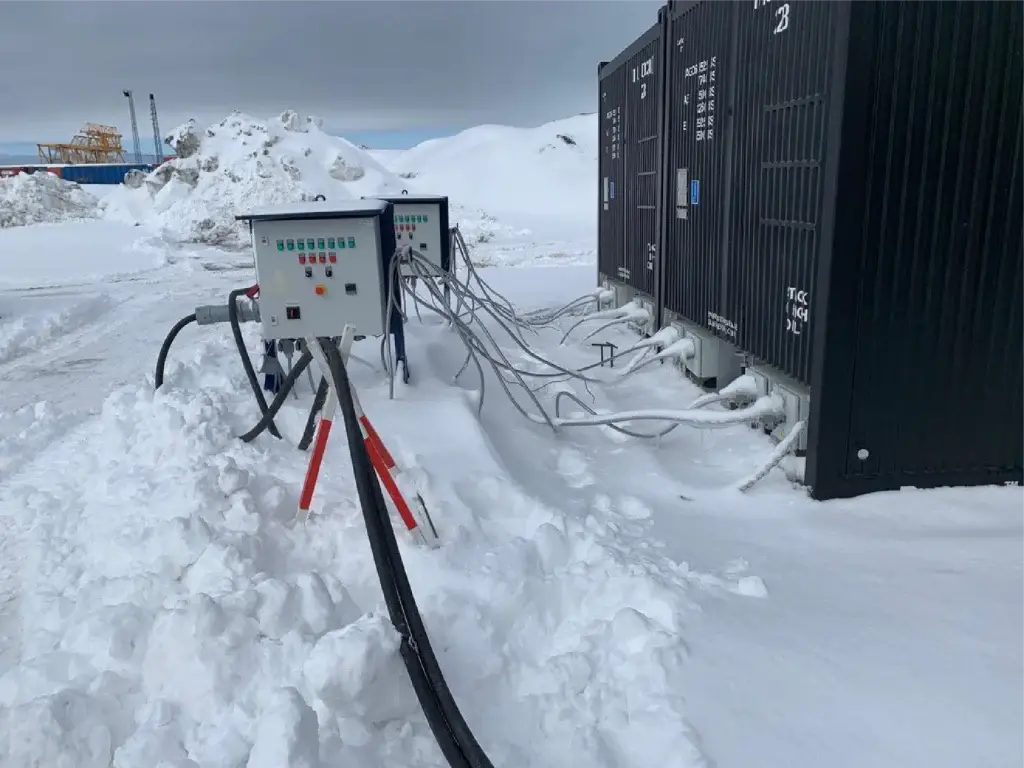
TEC has supplied Bitutainers™ for demanding cold-climate work, including airport resurfacing operations in Greenland, where insulation and heating configuration were central to keeping the supply chain workable across a short seasonal window.
The useful question is not whether the destination is hot or cold. It is what will happen to this specific grade, on this specific route, including every delay you can reasonably expect.
What good handling looks like
Most of what separates a smooth operation from a difficult one is planning rather than equipment.
- Match the loading temperature to the grade, the route and the expected dwell time, not to habit
- Confirm the receiving system is dry, has capacity, and is at temperature before the load departs
- Prepare the interfaces. Valves, hoses, pumps and receiving pipework all need to be ready, not just the tank
- Specify insulation and heating for the worst realistic case on the route, including delays
- Monitor continuously rather than checking on arrival
- For PMBs, crumb rubber and emulsions, plan for recirculation or agitation as well as temperature
- Avoid unnecessary reheat cycles by getting the first delivery window right
Where purpose-built equipment changes the outcome
Standard ISO tank containers are not designed for hot bitumen. They lack the integrated heating and thermal performance the product requires, which is why TEC builds a separate range for it.
The Bitutainer™ is a purpose-built bitumen container rather than an adapted general-purpose tank. The IMDG Bitutainer™ uses 100 mm mineral wool insulation with an internal heating configuration designed for extended transport and subsequent reheating. The Shipper Bitutainer™ uses double-walled construction with an internal heater tube arrangement specified for bitumen logistics. Heating options across the range include thermal oil, electric and direct fire, matched to the route and the operating environment.
Where a movement crosses borders or modes, the applicable framework matters as much as the equipment. Hot bitumen is a dangerous goods cargo under ADR for European road transport, RID for rail, and the IMDG Code for maritime shipping. Our guides to bitumen transport regulations and hazardous material codes cover what each requires in practice.
For site-based storage rather than transport, the MEST Bitutainer™ is a mobile bitumen storage and handling unit with integrated heating, pumping, monitoring and optional recirculation or agitation. Positioning a MEST close to a project allows full tanker deliveries to replenish local storage while spray trucks stay focused on application work instead of shuttling for product. Its double-walled construction also provides integral secondary containment, which can reduce the need for separate bund construction in suitable installations, subject to local site and regulatory requirements.
TEC has also used automated MEST installations to hold emulsion at a controlled 60°C with minimal operator intervention, which illustrates the wider point. As the product range broadens into emulsions, PMBs and crumb rubber binders, the equipment has to do more than hold a hot liquid. It has to preserve the condition the product was designed to be used in.
The one thing worth changing
If there is a single change that would prevent most avoidable bitumen handling problems, it is this: plan the discharge before you load.
Do not plan the journey as far as the site gate. Confirm that the receiving tank has capacity, that the system is dry, that the correct connection is available, that the pump and pipework are ready, and that the people on site understand the operation.
Most handling failures happen because one link in that chain was assumed rather than confirmed.
Bitumen temperature control is not a reading on a tank. It is a chain that runs from the refinery to the road.
Planning a bitumen movement and want a second opinion on the route? Request a quote or speak to our engineering team. We would rather assess the full route than give you a retention figure in hours that may not apply to your operation.
What temperature should bitumen be delivered at?
There is no single correct figure. Delivery temperature depends on the grade, the receiving operation and the viscosity required at discharge. Industry guidance generally relates handling to viscosity rather than temperature, with an approximate working rule of 100 cSt for storage, 200 cSt for handling and a maximum of 500 cSt for pumping. Always follow the binder supplier’s recommendation.
How long does bitumen stay hot in transit?
It depends on the loading temperature, grade, fill volume, tank insulation, ambient conditions, journey time and dwell time. A full, well-insulated container on a sheltered regional route behaves very differently from a partially filled unit on a winter journey involving port dwell time. Any answer given in hours without those variables is a marketing figure rather than an engineering one.
What happens if bitumen arrives too cold?
Discharge slows, the pump works harder and flow rates fall. In more severe cases valves, pumps or lines block and the load must be reheated before work can continue, which can take hours and disrupt the asphalt plant and paving programme.
Can bitumen be too hot?
Yes. Excessive temperature increases fuming and safety risk, and prolonged or repeated high temperature storage accelerates oxidation and hardening. Local overheating around heater elements can also create coke deposits that interfere with later pumping and mixing.
Why can't a standard ISO tank carry hot bitumen?
Standard ISO tank containers lack the integrated heating and thermal insulation that hot bitumen requires. TEC’s Bitutainer™ range is purpose-built for bitumen, emulsions and PMBs, with double-walled construction, dedicated insulation and integrated heating.
Do polymer-modified bitumen and emulsions need different handling?
Yes. PMBs and crumb rubber products may require recirculation or agitation to stay homogeneous, so temperature alone is not sufficient. Emulsions can be damaged by excessive heat and also by freezing or contamination, so they need controlled conditions rather than simply being kept hot.